Showing posts with label Ancient India. Show all posts

Tuesday, November 15, 2011

Sanskrit, English, and Greek: Recreating a Rosetta Stone

And the process continues! I think when it comes to translating languages or even just basic communicating, the process is never really finished. Even though each group created a Rosetta Stone, a finished product of translation between 3 languages, there were still imperfections, places to improve, things to add in. And so this is our process went…
We received the talipot palm leaf from the ancient Indian group. Thankfully, it was very legible and not terribly difficult to inscribe. We originally knew that it was written in Sanskrit, so that was our starting point. We noticed that there was a line, almost continuous, running through the text, but we didn’t know whether it went on the top or the bottom. Like Dr. Burton said, when using new languages, we have to reorient ourselves, whether we read the language right to left, clockwise, or upside down. From there, we tried to look up the translation character for character or word for word, but there are thousands of characters for Sanskrit, each connoting a different sound which then creates a word. We scrapped that idea and tried to find a specific authentic phrase they might have used. I knew, because Rachel is in our blogging group, that the Vedas were a sacred scriptural text very prominent in ancient Aryan culture. We then looked up the Vedas and found that the inscription came from the last line of the Rig Veda Book One, Hymn One. The phrase looked like this…
(check out this website for more on the Vedas’ history, content, and translation)


Wednesday, November 9, 2011

The name's Stone. Rosetta Stone.


Talipot Palm tree
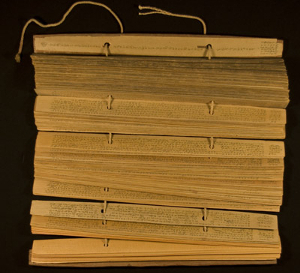
 This is almost exactly what our Indian-influenced artefact looks like, although admittedly ours had fewer leaves.  For our civilization group, we decided to use the medium of talipot palm leaves and a reed pen to cut into the surface, as the Aryans began doing during the Age of Sutra.  You can read more about their writing techniques in a prior blog post.

   The talipot palm leaves were used to write on until the age of print, when the recopying of deteriorating palm leaves became impractical.  The picture on top looks like an artefact shown during our time in Special Collections in the library.  The leaves were often connected by string through one or two holes, and book-ended by wooden, ivory, or other hard panels, either plain or adorned.

Thursday, November 3, 2011

A Treatise on the Art of Performing Everything


   After reading Andrew's post on written music this week, I began thinking about how writing down music would change our responses to, a civilization's sharing of, music.  While searching for more information about this in regards to Indian culture, I came upon the Natyasastra, which was basically an instruction guide for the arts written, presumably by many different people, around 100BC or earlier.

Thursday, October 27, 2011

Ancient Indian Cartography and Poets who Fall into Good Fortune

     We are about to delve into the interesting world of Ancient India maps.  Unfortunately, there aren't many maps from Ancient India, so this post will be on both maps and the patronage of kings during the Gupta Age.  In fact, Bagrow wrote in his "History of Cartography" that "India had no cartography to speak of ...no one in India seems to have been interested in cartography."


     He was kind of over-exaggerating.  The practice of cartography, according to P.D.A. Harvey, who wrote "The History of Topographical Maps," was either not very popular, or has left us with little evidence of its existence, but it is not non-existent, as Bagrow claims.  This may have, perhaps, had something to do with the emphasis on an oral language that the religious class of ancient India employed, but as we will see during the Age of Gupta, written works became quite popular among the ruling class of kings.