Oral, written, and printed knowledge all have an element of divisiveness to them. You must know someone else’s language in order to communicate effectively with them and those who can’t read or write are unable to use books to gain knowledge. If you are a professor whose articles have been published, you are held in higher regard than a professor who has not. Folk knowledge seems like it would represent an easily entered community, one that does not require a skill that is difficult to learn. However, knowledge that one person possesses and another does not is divisive in nature. Although folk knowledge can create a small community of people who share a certain type of knowledge or skill, the passing down of specific kinds of folk knowledge deters the existence of a large, open community. One must have a specific skill to be a part of it.
Showing posts with label Rachel Olson. Show all posts
Showing posts with label Rachel Olson. Show all posts
Wednesday, December 14, 2011

Tuesday, December 13, 2011
The Big One: Part One: Studies of our Past Blogs
This was an interesting process, to go back and remember all that we've learned this year. I agree with Summer that everything is about the process: how books are made, how the sharing of knowledge changes, how we learn about those changes, how we come to appreciate self-directed learning. I think that Dr. Burton and Dr. Petersen's goal was an apt one, to help us to be more humble and smart about our own ignorance. It's impossible to learn everything, but it is possible to appreciate knowledge enough to know that you don't know everything, and keep searching.
Thursday, December 8, 2011
A New View on Plagiarism: Printing Final Paper
Hey guys! I'm sorry I'm putting this up kind of late, but if you guys have time to comment on it, that would be great! I'm printing it out a little later today to give to the professors, so I'd really appreciate it. It's blue so it's more fun to read. My thesis is:
Although plagiarism was an acceptable practice in literature up until the invention of Gutenberg's printing press, the advent of the printed codex transformed plagiarism into an ill-regarded pursuit because of the financial gains that stem from the ownership of an idea.
Have a wonderful day!
Although plagiarism was an acceptable practice in literature up until the invention of Gutenberg's printing press, the advent of the printed codex transformed plagiarism into an ill-regarded pursuit because of the financial gains that stem from the ownership of an idea.
Have a wonderful day!
Thursday, December 1, 2011
The Printing Press and Science
| "The press descending from the heavens" |
Thursday, November 17, 2011
The Rise of the Author: Delving into the Depths of the Library
I decided to look into the Rise of the Author before the 1700's because of what we've talked about in class concerning who really authored oral epics. It was an interesting idea to me that an individual author hasn't always been the writer of a book, like a group of people who will write a autobiography for someone famous, or come up as a group with the idea for a book. I thought it was interesting that those people to whom we attribute great epics might not have been the sole writers; it might have been a conglomeration of ideas, a hodge-podge of stories through generations. And we don't even know who wrote Beowulf!
Well, I wanted this exploration into the print resources of the library for our bibliography requirement to be authentic, so I spent over two and a half hours walking up and down flights of stairs, sitting at computers, and then walking up and down more flights of stairs and rows of bookshelves until it was done!
I decided to look up sources pertaining to the "Rise of the Author before 1700," first because it sounds cool, and second because my desire to write a book and be an author is helping me to feel particularly kinship-y with this class of people.
Well, I wanted this exploration into the print resources of the library for our bibliography requirement to be authentic, so I spent over two and a half hours walking up and down flights of stairs, sitting at computers, and then walking up and down more flights of stairs and rows of bookshelves until it was done!
| The magnificent HBLL |
Thursday, November 10, 2011
The King James Bible, "She-Bibles," "He-Bibles," and all that jazz
This link is to a classical radio station so you have the option of feeling particularly cultured while reading this post, if you want to. Deep in the depths of the Harold, there is a room. Within that room, there is another room, a smaller room, partitioned off by what appear to be stained glass windows, and within that room are... a lot of Bibles.

That's right. We are now in "The Life and Legacy of The King James Bible," the exhibit currently on display in BYU's Special Collections, and it is now 405 A.D. Saint Jerome has finally finished his translation of the Greek and Hebrew Bibles into Latin, what will later be known as the Vulgate Bible. This is written on vellum, and will eventually be the Bible most used by all of Western Europe up through the Middle Ages. You can read more about the history of the King James Bible here.

That's right. We are now in "The Life and Legacy of The King James Bible," the exhibit currently on display in BYU's Special Collections, and it is now 405 A.D. Saint Jerome has finally finished his translation of the Greek and Hebrew Bibles into Latin, what will later be known as the Vulgate Bible. This is written on vellum, and will eventually be the Bible most used by all of Western Europe up through the Middle Ages. You can read more about the history of the King James Bible here.
 |
| The Vulgate Bible |
Wednesday, November 9, 2011
The name's Stone. Rosetta Stone.
 |
| Talipot Palm tree |
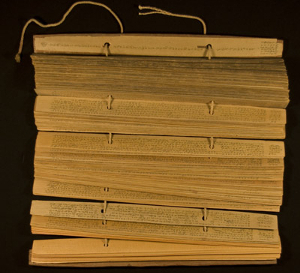
The talipot palm leaves were used to write on until the age of print, when the recopying of deteriorating palm leaves became impractical. The picture on top looks like an artefact shown during our time in Special Collections in the library. The leaves were often connected by string through one or two holes, and book-ended by wooden, ivory, or other hard panels, either plain or adorned.
Thursday, November 3, 2011
A Treatise on the Art of Performing Everything

After reading Andrew's post on written music this week, I began thinking about how writing down music would change our responses to, a civilization's sharing of, music. While searching for more information about this in regards to Indian culture, I came upon the Natyasastra, which was basically an instruction guide for the arts written, presumably by many different people, around 100BC or earlier.
Thursday, October 27, 2011
Ancient Indian Cartography and Poets who Fall into Good Fortune
We are about to delve into the interesting world of Ancient India maps. Unfortunately, there aren't many maps from Ancient India, so this post will be on both maps and the patronage of kings during the Gupta Age. In fact, Bagrow wrote in his "History of Cartography" that "India had no cartography to speak of ...no one in India seems to have been interested in cartography."

He was kind of over-exaggerating. The practice of cartography, according to P.D.A. Harvey, who wrote "The History of Topographical Maps," was either not very popular, or has left us with little evidence of its existence, but it is not non-existent, as Bagrow claims. This may have, perhaps, had something to do with the emphasis on an oral language that the religious class of ancient India employed, but as we will see during the Age of Gupta, written works became quite popular among the ruling class of kings.

He was kind of over-exaggerating. The practice of cartography, according to P.D.A. Harvey, who wrote "The History of Topographical Maps," was either not very popular, or has left us with little evidence of its existence, but it is not non-existent, as Bagrow claims. This may have, perhaps, had something to do with the emphasis on an oral language that the religious class of ancient India employed, but as we will see during the Age of Gupta, written works became quite popular among the ruling class of kings.
Thursday, October 20, 2011
The Lotus Temple
If we had to pick a star for each blog post we wrote, the star of this blog post would be my lovely sister, Sarah, who drove with me today to the Krishna Lotus Temple in Spanish Fork for a tour and general adventuring. After getting our very authentically Indian Sonic breakfast burritos, we headed over to the beautiful white temple on a hill. This is my sister, Sarah.
 |
| It was her birthday, when this picture was taken. |
Thursday, October 13, 2011
Why the Brahmins Didn't Want Writing
"And when you have seen, heard, perceived, and known the Self you will know all things," the wise man Yajnavalkya once told his wife, Maitreyi.
Before we go into the reasons for this particular religious class, as opposed to those throughout history like the priest of the 1500's who have hoarded their knowledge of writing, we should probably talk about why the Aryans started schools in the first place. The Aryans, whose religion we find out about through the Rigveda, believed that in order to escape a never-ending cycle of birth and death, otherwise known as transmigration, one needed to become a part of the Whole, to merge one's soul with Brahman, or the universe. In order to do this, one needed to know. The Vedas, an Aryan religious text, comes from the root word vid, which means "to know."
 |
| Yajnavalkya, spoken of in the Upanishads |
Thursday, October 6, 2011
Gurcharan Gill, PhD, and the Aryans
First off, this is some music of ancient India I found for reading a blog and listening enjoyment. Enjoy!
Tuesday, October 4, 2011
Group 7's Video Blog Post
This is Group 7's video blog post on mnemonics and what types of memorizing are really valuable in our time, and were valuable in ancient civilizations. Enjoy! :)
<iframe width="425" height="349" src="http://www.youtube.com/embed/n0EUBfwm8HE?hl=en&fs=1" frameborder="0" allowfullscreen> -
<iframe width="425" height="349" src="http://www.youtube.com/embed/n0EUBfwm8HE?hl=en&fs=1" frameborder="0" allowfullscreen> -
Thursday, September 29, 2011
The Upanishads, translated by Michael N. Nagler
You may be asking yourself right at this very moment, "What is 'Upanishad?'" and "How do I pronounce that strange-looking word?" and those would be good questions. The second question is simpler, so let's start with that. If you were to ask google translate how to pronounce it with a Spanish accent, it would sound a little like oo-PAWN-ee-Shawd.
This little exercise we just did, in itself, was interesting - just because the name is written doesn't mean I know how to communicate how it sounds to you without depending on our oral skills.
This is my attempt at recitation
This video is a recording of my recitation of part of one of the Upanishads, which can be found in Michael Nagler's translation of ancient Hindu scripture. Through reading some of the Upanishads, I learned that this ancient Aryan civilization believed wealth would not lead to happiness, and that eternal happiness comes through recognizing that we are all part of a Self. As Yajnavalkya tells his wife, Maitreyi, in Brihadaranyaka Upanishad, "Everything is loved not for its own sake, but because the Self lives in it."
Thursday, September 22, 2011
Okay, team
Summer and I were having a discussion after class, and we thought it might be a good idea to find pride in our Freshmen-ness; other groups might have a diversity of years (and marriages and babies and missions) to give them perspective, but we've got the freshmen force. For that reason, we were wondering if maybe we could vote on keeping the old name, "The Lost Diadem," which is cool, or trying out some play on Freshmen and Refreshments quotes, or something... wait! Hear us out!
We could be...
"On a long journey of human life, faith is the best of companions; it is the best reFRESHMEN on the journey (he he); and it is the greatest property." -Buddha quotes
or...
"Love is the greatest reFreshmen in life." -Pablo Picasso
or
"To sit in the shade on a fine day and look upon verdure is the most perfect reFreshmen." -Jane Austen
or... he he he...
"Universities are full of knowledge; the freshmen bring a little in, the seniors take none away, and the knowledge there accumulates." -Abbott Lawrence Lowell
Just kidding about that one. :)
"I would assume that you were going to offer me reFreshmen, but the evidence so far suggests that that would be optimistic to the point of foolishness." -Albus Dumbledore
"Silence is reFreshmen for the soul." -Wynonna Judd
I hereby acknowledge that some of them make little to no sense, but what do you think? Should we wear our class status with pride? We were thinking we could vote on it. What do you think?
We could be...
"On a long journey of human life, faith is the best of companions; it is the best reFRESHMEN on the journey (he he); and it is the greatest property." -Buddha quotes
or...
"Love is the greatest reFreshmen in life." -Pablo Picasso
or
"To sit in the shade on a fine day and look upon verdure is the most perfect reFreshmen." -Jane Austen
or... he he he...
"Universities are full of knowledge; the freshmen bring a little in, the seniors take none away, and the knowledge there accumulates." -Abbott Lawrence Lowell
Just kidding about that one. :)
"I would assume that you were going to offer me reFreshmen, but the evidence so far suggests that that would be optimistic to the point of foolishness." -Albus Dumbledore
"Silence is reFreshmen for the soul." -Wynonna Judd
I hereby acknowledge that some of them make little to no sense, but what do you think? Should we wear our class status with pride? We were thinking we could vote on it. What do you think?
Can you say Shibboleth for me?
watch from 2:58 to 6:42
First off, I really had to put this movie clip from the movie "Wit" with Emma Thompson, about an English professor undergoing chemotheraphy because it is just so great! Also, the main character describes why, to her, language has such power, and why she loves it.
Saturday, September 17, 2011
More on the Mother Tongue
I just came across this in a textbook reading I have for English, and it was pretty cool. It's by this African-American female professor and feminist, Gloria Watkins, who goes by bell hooks in her writing, about women's concerns with teaching Women's Studies in a university setting. Read more about bell hooks here.
Friday, September 16, 2011
"The World Cannot Be Governed Without Juggling."
Skylar's first recorded attempt at juggling three pears
Thursday, September 15, 2011
Colombian Hot Chocolate
“Love is like swallowing hot chocolate before it has cooled off. It takes you by surprise at first, but keeps you warm for a long time.”
 |
| Traditionally, a chocolatera (aluminum pitcher placed directly on stove) and a molinillo (wooden mixer) are used for the process |
This summer, I had the awesome opportunity to travel to Colombia with family friends from my congregation in Lynbrook, New York, who were headed back to their country for the first time in ten years.
Wednesday, September 14, 2011
Slip, Chain Two, Double Crochet

My wonderful roommate Hannah and her basket of yarn
These are the instructions that my roommate, Hannah, wrote on a yellow sticky note in a firm hand for me after our crochet lesson this evening: "Petal loop: [Slip, chain 2, double crochet (yarn over twice, catch yarn through loop, yarn over, pull through two loops ('til one loop left) double crochet 3 times, chain 2, slip into same] slip into next loop."
She ended with REPEAT.
Subscribe to:
Posts (Atom)