Showing posts with label Ancient Greece. Show all posts

Tuesday, November 15, 2011

Sanskrit, English, and Greek: Recreating a Rosetta Stone

And the process continues! I think when it comes to translating languages or even just basic communicating, the process is never really finished. Even though each group created a Rosetta Stone, a finished product of translation between 3 languages, there were still imperfections, places to improve, things to add in. And so this is our process went…
We received the talipot palm leaf from the ancient Indian group. Thankfully, it was very legible and not terribly difficult to inscribe. We originally knew that it was written in Sanskrit, so that was our starting point. We noticed that there was a line, almost continuous, running through the text, but we didn’t know whether it went on the top or the bottom. Like Dr. Burton said, when using new languages, we have to reorient ourselves, whether we read the language right to left, clockwise, or upside down. From there, we tried to look up the translation character for character or word for word, but there are thousands of characters for Sanskrit, each connoting a different sound which then creates a word. We scrapped that idea and tried to find a specific authentic phrase they might have used. I knew, because Rachel is in our blogging group, that the Vedas were a sacred scriptural text very prominent in ancient Aryan culture. We then looked up the Vedas and found that the inscription came from the last line of the Rig Veda Book One, Hymn One. The phrase looked like this…
(check out this website for more on the Vedas’ history, content, and translation)


Wednesday, November 9, 2011

Papyrus, Stone, or Clay?:Recreating an ancient Greek artifact


If there’s one thing I’ve learned about this civilizations class, it’s that it’s all about the process. And as for our ancient artifacts we had to recreate, it was no different. In my group of ancient Greece, we began brainstorming different ideas for the medium we could use. Papyrus was first proposed. Interestingly enough, the word "paper" is etymologically derived from papyros, Ancient Greek for the Cyperus papyrus plant.
blank papyrus
 (notice the grains from the reeds)

Tuesday, November 1, 2011

Written Music?


I love music. Most especially, I love sheet music. Before coming to BYU, I gathered every Elton John, Jon Schmidt, and every Broadway songbooks that I could stuff into one crate. The concept of spreading musical knowledge of sheet music has been one that I am personally grateful for. It’s one thing to hear “Piano Man”, but to actually take part in performing it with my own personal interpretation creates a joy beyond compare.
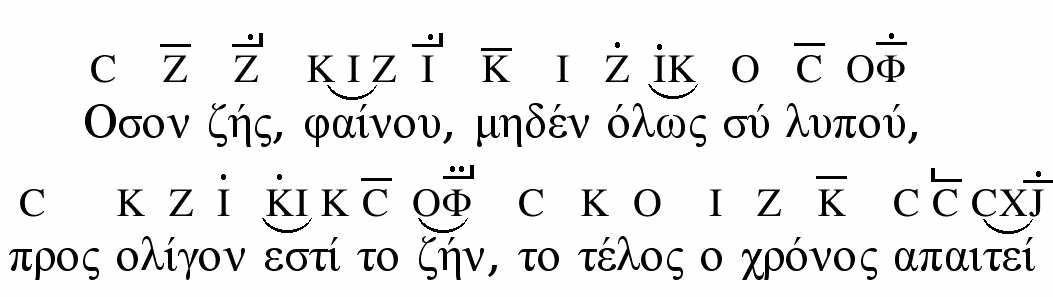
For this reason I decided to make my blog post about ancient musical notation. In a way, music encompasses all forms of knowledge (folk, oral, written, digital). Today I’d like to focus on the written from of music. ( Below is a sample a Ancient Greek musical notation.).
And so began my internet search for the oldest piece of musical notation. I found the Seikilos Epitaph which is an ancient tomb near Turkey (shown in the image at the start of this post). This tomb contains an engraving of the oldest full musical composition ever discovered. The tune is simple and somewhat illogical, but that’s to be expected from ancient times. As Alex pointed out in his post, writing mediums play a big role in determining the sophistication of a written piece. The epitaph was engraved in stone which is a difficult medium to record written information.
The epitaph proved that in order for music to endure, it must be written down. Ancient civilizations didn’t have the modern convenience of audio recordings. So how did familiar tunes spread across civilizations? That’s where the power of musical notation comes in. It allows for civilizations to connect to each other through music.
However, a paradoxical aspect of music is that it can survive without notation as well. The great Jazz musicians incorporated improvisation techniques that allow for more freedom in music without written scales or melodies. All the musician need was chord progression and a general knowledge of the song, and then from there he could create whatever he desired. Music like that can’t be written down, and those who try to duplicate it exactly end up with a cheap rendition of a something pure.
So in conclusion, music sould be recorded almost certainly—just it should be more of a starting point. The best music comes without physical notation but from within the mind and soul of the musician.

Wednesday, October 26, 2011

It's All Greek to Me


You could say that architecture is age old, whether the design is a rock-enclosed cave or an elaborate, complex palace.  So I guess the question is how did architecture change as a result of a literate society? This question can be answered through the tradition of ancient Crete and mainland Greece. To thoroughly study this, I will include the architecture of the Minoans and Mycenaeans during the Helladic Age and then the Ionian and Classic Greek cultures of the Hellenic Age.
inverted columns at the palace of Knossos

Wednesday, October 19, 2011

You Just Got Schooled

As I have mentioned in previous posts, the Minoans of ancient Crete did have a written language entitled Linear A by the archaeologist Sir Arthur Evans, who is attributed for much of his work with the Linear A script. Now, the artifacts that contain this writing are few and have yet to be fully translated. However, the script of Linear B, which existed later with the Mycenaeans on Crete, has been translated through the use of ancient Greek and can be used to decipher some Linear A characters. 

Wednesday, October 12, 2011

Voice Into Text

When I did my research for oral knowledge in ancient Greece, I checked out a big stack of books. When I got home, I dismissed the book Voice Into Text: Orality and Literacy in Ancient Greece because it didn’t deal strictly with oral culture. But with the admonition to participate in self-directed learning, I decided to explore. I soon found a pertinent chapter entitled “Greek Oratory and the Oral/Literate Division” by Ian Worthington. It discussed the transition from a mainly oral society into a mainly text-based society, and the importance behind these mediums. Sound familiar?

Wednesday, October 5, 2011

Expert Findings--Excavations of Ancient Greek Orality


NEEDED: An authority on ancient Greek oral traditions, preferably Minoan culture with a specialty in mnemonics.
The reigning expert? William Brockliss, professor of Classics 110 and Greek 301 (Classic Greek Poetry). His education comprises of degrees at both Oxford and Yale, and his research encompasses the interaction between Homeric epics and the environment.
Like I mentioned in my post last week, little is known about Minoan culture. What we do know of the civilization is seen through the lens of the Greeks because the Minoans do not have surviving artifacts or stories to represent themselves. And so I will broaden my topic to that of the ancient Greeks. Even then, Professor Brockliss said that Homeric poetry was composed in a specific dialect, making it like an archaeological dig to find the meanings and nuances of the text. And so we will dig! To better reflect the style of my oral interview with Professor Brockliss, I will reflect my findings in question and answer format, touching on a few of the subjects we discussed.

Wednesday, September 28, 2011

Dr Seuss v. Homer: A comparison in mnemonics


I was nervous, my palms sweating as I swallowed the knot in my throat. You can do this, I told myself. Just keep calm. But it‘s hard to keep your cool when your entire 5th grade class is staring at you. I closed my eyes, opened my mouth, and the words just started to flow.