Monday, October 10, 2011

Listen to the Man!


Considering how I am writing this post 8 hours before our oral midterm, I thought it might be interesting to investigate the power of public speech in both a historical and contemporary sense.
First, let’s address the Greeks, since they are allegedly the masters of rhetoric. I was reading an article about the art of persuasion in Ancient Greece, and I became interested in one of the points made by an obscure philosopher that I’ve never heard of named Gorgias (sorry Professor Burton if you know who he is). Anyways, he gave an interesting argument in his Encomium of Helen that having command over the rhetoric word gave one considerable power and influence over others:
“The effect of speech upon the condition of the soul is comparable to the power of drugs over the nature of bodies".
He likens this philosophy to Helen of Troy and argued that one of the reasons she was carried off so easily was because of the power of speech, specifically an appeal to pathos.
So that got me thinking about the power and devices of different political leaders throughout history and how they were able to effectively unite their respective followers. In my own civilization that I was assigned, I learned about the Islam prophet Muhammad. I mentioned in one of my earlier posts that he was an illiterate merchant who knew nothing of rhetoric or education, yet he became one of the most influential leaders of all time. He united an entire empire that eventually grew to become the Ottoman Empire.
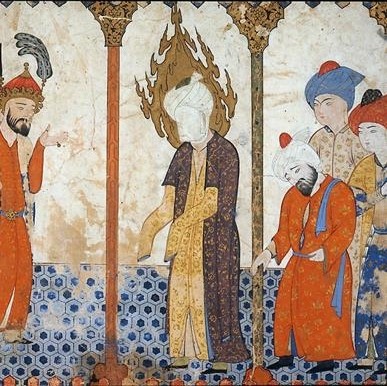
It seems that the effectiveness of speakers is measure by the level of change that is wrought upon the hearts of his/her listeners.


I also reflect on the power of King Benjamin’s speech in this sense. In Mosiah, we learn that King Ben gave such an effective speech (enhanced by the Holy Spirit of course) that he brought the whole multitude to their knees to cry with one voice for forgiveness of their sins. The whole multitude! Not part, but the whole multitude was moved and effectively “there was not one soul…who had taken upon them the name of Christ.” Even if you aren’t religious you can appreciate the power behind one man’s ability to orate to an audience.
In a modern example, I recently read a speech that Barrack Obama gave in 2009 in Egypt while addressing to the Muslim world. In the speech, I was amazed at his strategies to appeal to an Islamic community. He must have had extensive knowledge of his audience before choosing his words. Proof of this is when he alludes to Muhammad he says the all-important phrase “peace be unto him”. To an Islam, the phrase is one that is used whenever the Prophet’s name is mentioned. The fact that a Westerner recognized that tradition of using that phrase portrays a heightened respect for another culture, no doubt Muslims were impressed. I guess that’s why Obama won the Nobel Prize, right?
Anyways to wrap up, I’d like to just highlight that the spoken word has a profound effect on those who listen. Not just with public speeches, but in everyday life as well. Imagine if we viewed ever y compliment, every insult, and every joke with the same gravity in which what we say may drastically impress another person for better or for worse.
Book of Mormon: Ref. Mosiah 4:1-3; 5:2
“A New Beginning”, President Barrack Obama; Address at Cairo University, June 4, 2009
(Not sure of exact citation since it was a PDF file)

Sunday, October 9, 2011

A Word Borrowing Fiesta!

It seems like all languages are influenced by the languages of other cultures that either conquer them or are geographically near to them, and in many cases there is just blatant word stealing (or word borrowing... is that the politically correct term?). Some easy examples I can think of are "shared" between the U.S. and Mexico. Words like email, yanqui and carro are used in Mexican Spanish, and words like burrito, rodeo and tornado are used in American English. These words seem to only come when there is something new introduced into a culture that there was no word for before. It doesn't seem very common for one language to simply replace its own words with another's. For example, the English language didn't have a word for meat and beans wrapped in flat bread, so "burrito" is used. The Spanish language (or any language for that matter) had no word for messages sent electronically via the internet, so it as well as many others adopted the American word "email". Ancient Welsh was no exception to this.


Thursday, October 6, 2011

Gurcharan Gill, PhD, and the Aryans

First off, this is some music of ancient India I found for reading a blog and listening enjoyment.  Enjoy!


Wednesday, October 5, 2011

Expert Findings--Excavations of Ancient Greek Orality


NEEDED: An authority on ancient Greek oral traditions, preferably Minoan culture with a specialty in mnemonics.
The reigning expert? William Brockliss, professor of Classics 110 and Greek 301 (Classic Greek Poetry). His education comprises of degrees at both Oxford and Yale, and his research encompasses the interaction between Homeric epics and the environment.
Like I mentioned in my post last week, little is known about Minoan culture. What we do know of the civilization is seen through the lens of the Greeks because the Minoans do not have surviving artifacts or stories to represent themselves. And so I will broaden my topic to that of the ancient Greeks. Even then, Professor Brockliss said that Homeric poetry was composed in a specific dialect, making it like an archaeological dig to find the meanings and nuances of the text. And so we will dig! To better reflect the style of my oral interview with Professor Brockliss, I will reflect my findings in question and answer format, touching on a few of the subjects we discussed.

Tuesday, October 4, 2011

Group 7's Video Blog Post

This is Group 7's video blog post on mnemonics and what types of memorizing are really valuable in our time, and were valuable in ancient civilizations.  Enjoy! :)

<iframe width="425" height="349" src="http://www.youtube.com/embed/n0EUBfwm8HE?hl=en&fs=1" frameborder="0" allowfullscreen> - 

Monday, October 3, 2011

Islam: An Oral Religion Part 2

First off, I’d like to comment on the difference between basing my blog post off an oral interview rather than a text. I interviewed Dr. Kent Jackson from the Religion Department who teaches my Islam and the Gospel class that I related to on my previous post. What an experience! Professors are honestly holding these enormous vats of knowledge in their brains that students have access to if they take the initiative. For example, I was able to find the answers to nearly all my questions regarding education in the Islamic culture in the space of 20 minutes—I doubt you could be even remotely productive using the internet.
Also, there is sense of academic pride that comes along with having an intellectual conversation orally. You are able to learn more when you are actively engaged in conversation rather than staring longingly at Google Search screen.
Anyways here are a few of the interesting facts I discovered about the Ottoman Empire:
· Educational institutions were modeled after Europe
· 95% of the citizens were illiterate
· No central language as the Empire was vastly diverse
· No Printing Press system as compared to the large expansion in Europe
These historical facts determine that the essence of the Islamic culture had to be preserved by oral means. Muslims were able to preserve their religious culture through regularly attending the mosque and listening to the sermons provided the imams (educated Islamic teachers).Muslims could then learn the doctrine and further transmit religious knowledge to their families.
One of the most highly valued forms of oral knowledge in Islamic culture is the act of memorizing Qur'an. Even today, Muslims find it an effective source of spirituality and showcase of their dedication to Allah (not too different from memorizing Scripture Mastery). Here is a picture of Muslims attending an annual Memorization conference. Unfortunately, my teacher couldn’t provide me with any mnemonic techniques that Muslims incorporate with memorizing the Qur'an. However, he did provide me with an additional person with whom I can consult. That’s the thing about oral knowledge, you have to interact with more than one person to understand the whole picture. Hopefully, I can gain some more information and do a follow up post later.
During my interview, the weaknesses of oral communication in Islamic culture were brought to my attention. Mainly, these weaknesses center around the fact that Islam does not have a central religious figure today. They believe all prophet-like revelation ended with Muhammad, and the only true authority lies with the Qur’an itself. The lack of central authority allows for multiple oral interpretations of Islam to roam free without check. Usually, central authorities (such as within the LDS church) are responsible for weeding out discrepancies being orally transmitted by wrongly-guided members. In result, the Islamic culture is full of unofficial traditions.
For example, the head cover that women wear in Islamic culture is not actually an official statement within the Islamic religion. The Qur'an never mentions it. Most likely, this tradition was started orally by some historic event and has become assimilated into Islamic culture ever since.
The fact that Islam has prospered for hundreds of years is living proof of the effectiveness of oral-knowledge. It may seem ridiculous to hear of people memorizing religious texts simply because we cannot see the practical application to the material world. However, preserving culture is not necessarily of the world…it lies deep within the human subconscious (as Summer pointed out in her comment on the previous post). That’s why we memorize, not to be practical, but to gain the X-factor that enables us to connect to something deeper than our physical existence.

Seasonal Songs in Wales

Brief Overview
For an extremely brief historical background on Wales, see the first paragraph of my last post. Wales is know as a "land of song". (I had never heard this before, but it says so in The Welsh Academy Encyclopedia of Wales). This title was born in the 19th century when Wales saw an explosion of musical fervor, that was displayed starting in 1861 in Eistedfod, a large Welsh cultural festival. Unfortunately, this 19th century idea masks the rich history of music in Wales dating back to Pagan times. Songs were used to celebrate the seasons (Winter Solstice, the coming of spring, Summer Solstice), the new year, etc. I'm going to go the route of a general authority at conference and divide my blog post into three subtopics that will hopefully better enable you to remember the message of this post.